

Disciple:
A Journey
The Official Rulebook
This page represents the most current rules. In any conflict with printed materials, this page takes precedence.
Introduction
Disciple: A Journey is a tabletop deckbuilding game with a mixture of adventure and roleplaying. You start by picking a style of martial arts to learn. You will have a beginning deck and skills deck. As you play through the many events in the game, you will build on your beginning deck with new skills in hopes to reach the end of your journey and defeat the final boss.
Are you ready, Disciple?!
What's in a Card
This next section will label and describe all the parts of the different cards used in Disciple. There are Skill cards, Style cards, Event Cards which include Enemies, and Attack Patterns.
Skill Cards
Skill cards have 6 different types. These are played by paying their energy cost. Energy comes in 4 colors: gray, blue, red and green. Any color can be used for gray costs, but only matching colors can be used for the other color costs. The type as shown below, from left to right are:
Generic Upperbody Lowerbody Grapple Stance Style

Most skill cards will be played and discarded as soon as their effects resolve. Some Generic cards called ‘States’ will stay in play until replaced by another ‘State’ card. You can only have one Stance card in play at a time. If you have a stance card in play, and play another Stance, the first Stance will be discarded and the new Stance put into play in its place. The same applied to Style cards, a new style will replace an old Style.
If Card text changes these rules, then it takes precedence over the rulebook**
Style Cards also have 4 Rarities, as shown below from left to right:
Common Uncommon Epic Legendary

The Rarity of a card comes with its own rules for Skills Deck construction. Common cards can not have more than 4 copies, Uncommon no more than 3, Rare no more than 2, and Legendaries can only have 1 copy. Also, a deck cannot have more than 10 of each rarity, regardless of the type (i.e. 10 Upperbody Legendaries, or 5 Generic and 5 Grapple).
Skills cards have other parts to be aware of, as shown below:
-
Cost: Color and amount of Energy of that color needed to pay to play this card.
-
Title: Name of the Card.
-
Type: The border shows you the type of the card.
-
Effects: The effects of the card when played.
-
Rarity: The border of the Title and Description show the rarity of the case
-
Description: Tells you what style, and category the card belongs to

Event Cards
Event cards include enemies, healing stations, and others. Non-enemy and enemy cards have similar parts, but also Enemies have unique elements.
-
Title: Name of the Event card
-
Effects: The effects of the Event, often a choice of options.
-
Group: The Group number this Event belongs to.
-
Style: The style this card belongs to.

-
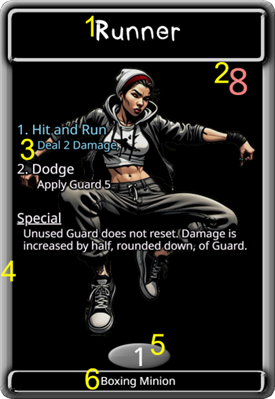
Name: Name of the enemy.
-
Vitality: Lowered by Damage, If it lowers to 0 or less, you lose.
-
Attacks: Enemies attacks and Special effects. The Color of the words indicates the type of action.
Blue: Upperbody Red: Lowerbody Green: Grapple White: None -
Group: Group number this enemy belongs to.
-
Type: Border color indicates enemy type; light gray for Minions, dark gray for Minibosses, black for Bosses.
-
Description: Tells the style the card belongs to and the type of enemy on the card.
Style Cards
Style cards contain several pieces of information about the style you are currently playing. They are double sided, with a list of Keywords on the back. If using more than one style, keep both style cards to reference Energy allotment.
-
Style: The name of the style represented on the card
-
Energy Allotment: The type and number of common
Energy cards a Disciple of this style starts with in play. -
Starting Deck: The list of cards to be added to the
Starting Deck when playing Solo, Co-Op, or Campaign.

Attack Patterns
Attack Patterns tell you how the Enemy attacks during their turn. Draw the top card of the Attack Patterns pile at the beginning of the Enemy’s turn. Draw only one card unless otherwise directed by cards or keywords. If an Enemy attacks multiple times in one turn, draw the next card at the time of the subsequent attacks. At the end of the Enemy’s turn, the drawn cards go back on the pile and the pile is shuffled.
-
Minion Attack Pattern
-
Miniboss Attack Pattern
-
Boss Attack Pattern

What's in a Deck
To keep the gameplay fun and fair, there are rules for building a Skills Deck. All default decks already adhere to the rules for ease of use, but the rules must be observed when adding expansions or during Versus.
Skills Deck Rules:
Except for Versus and Campaign, Skills Decks may only consist of cards from a single martial arts style.
Decks must have at least 60 cards in them.
Decks must follow the Rarity rules:
Decks may only have up to 10 unique skills of each rarity.
Decks may only have up to 4 copies of any common card.
Decks may only have up to 3 copies of any uncommon card.
Decks may only have up to 2 copies of any epic card.
Decks may only have up to 1 copy of any legendary card.
Keywords
DISCIPLE GLOSSARY AND KEYWORDS
The following is a list of keywords and terms used in Disciple: A Journey, along with their meanings and applications.
CARD TYPES
Upperbody: A card with a blue border.
LowerBody: A card with a red border.
Grapple: A card with a green border.
Generic: A card with a gray border.
Punch: An Upperbody card with "Punch" in the description box.
Elbow: An Upperbody card with "Elbow" in the description box.
Kick: A LowerBody card with "Kick" in the description box.
Knee: A LowerBody card with "Knee" in the description box.
Choke Hold: A Grapple card with "Choke" in the description box.
Joint Lock: A Grapple card with "Joint" in the description box.
Pressure Point: A Grapple card with "Point" in the description box.
Stance: A card with a white border and "Stance" in the description box. Stances remain in play until replaced by another Stance or removed when Rocked is received. Only one Stance may be in play at a time.
Guard (Stance): A Stance card with "Guard" in the description box.
Control (Stance): A Stance card with "Control" in the description box.
Mount (Stance): A Stance card with "Mount" in the description box.
Style: A card with a black border and "Style" in the description box. Styles remain in play until replaced by another Style. Only one Style may be in play at a time.
State: A Generic card with "State" in the description box. States remain in play unless replaced by another State.
Common: A card with a gray title and description border.
Uncommon: A card with a silver title and description border.
Epic: A card with a gold title and description border.
Legendary: A card with a black title and description border.
BUFFS
Power: Adds the listed number to the next damage dealt this turn. It does not count as a separate attack.
Guard: Reduces incoming damage by 1 per Guard. Guard also reduces Submit damage. Guard fades at the beginning of the next turn.
Example: Disciple gains Guard 5. Enemy attacks for 3 damage. Guard absorbs the damage and drops to Guard 2. At the start of the Disciple’s next turn, all Guard is lost.
Clinch: Enhances the next attack.
If the next attack is Upperbody, apply Rocked on hit.
If LowerBody, apply Submit equal to half the damage dealt.
If Grapple, deal the full Submit as damage and apply Clinch again.
If the card has no type, apply Weakened.
Feint: The opponent’s Guard is ignored by the next damage dealt immediately after Feint is applied. Guard still applies to later damage.
Example: Enemy has Guard 5. Disciple uses Feint and deals 3 damage. Enemy loses 3 health. If Disciple then deals 2 more damage, Guard blocks it.
Combo: Cards listed after Combo cost 1 less to play if played immediately after the Combo card.
Flow: Triggers if the card was listed in a Combo on the previously played card. If triggered, resolve the actions after the colon up to the next empty line.
Lock It In: Cards listed after Lock It In are the condition and must be in play. When triggered, the attack becomes a State card and remains active until:
The opponent deals damage equal to the listed value, OR
The condition is no longer met.
Focus: Resolves when played and again at the start of each turn while it remains active.
DEBUFFS
Exposed: Opponent immediately loses all Guard.
Rocked: Opponent discards any Stance in play. If Rocked applied in one turn exceeds the enemy limit, the enemy is knocked out and you win.
Minions limit: 2
Miniboss limit: 3
Boss/Player limit: 4
Submit: Opponent loses Vitality equal to half the Submit applied, rounded up. If Submit applied at once exceeds the opponent’s remaining Vitality after reduction, they tap out and you win.
Weakened: Opponent discards a random card from their hand.
In Solo, when the Disciple applies Weakened, the Enemy draws two attack cards and the Disciple chooses which one is used.
Stun: Opponent taps one Energy card.
In Solo, when the Disciple applies Stun, the Enemy skips the first attack in their next Attack Pattern.
UTILITY TERMS
Player: The real person playing the game. You.
Disciple: The player. You again.
Enemy: Any Minion, Miniboss, or Final Boss from the Event Deck or Boss Mat.
Opponent: The fighter currently facing another. The Disciple is the Enemy’s opponent, and the Enemy is the Disciple’s opponent.
Apply: Make a buff or debuff active. The target is implied by the card text or effect description.
Damage: Lowers an opponent’s health.
Attack: An action that generally deals damage. If text says "Attacks deal double damage," the damage value doubles. If it says "Attacks two times," it means two separate attacks.
Deals: Implies an attack.
"Deals 2 damage twice" means two attacks.
"Deals 2 damage. Deals 4 damage" also means two attacks.
"Deals double damage" means one attack with increased damage.
Skills: Any card that can be played by the Disciple.
Energy: The currency used to play cards. Energy comes in blue, red, green, and gray.
Any color may pay gray costs.
Gray energy may only pay gray costs.
Colored costs must be paid with matching energy.
To gain Energy, tap an Energy card and collect the listed amount.
Unused gathered Energy fades at End of Turn.
Vitality: Your health. If it reaches 0 or less, you lose.
Starting Vitality:
Solo and Co-Op: 25
Versus: 50
Campaign: As decided
Vitality does not automatically refill after combat.
Counter: A Counter card shows "Counter:" followed by a trigger condition and response.
In Solo, Co-Op, or Campaign, place counters face up in front of the player.
In Versus, counters are placed face down to keep the trigger secret.
Counters are discarded after resolving or at the next Beginning of Turn of the player who played it.
Playstyles
This style allows a player, also called a Disciple, to play by themselves. A Disciple will select their beginning martial arts school and follow the adventure drawn from the event deck until the Disciple is defeated or they defeat the final boss and are victorious
This style allows two Disciples to compete against each other. Each will start with a full skills deck and will take turns using skills to attempt to defeat their opponent. It ends when one Disciple is defeated and the other is victorious.
This style allows two Disciples to play together. Each Disciple will select a beginning martial arts school and the corresponding event deck. Then together they will follow the adventure drawn from the event deck until all Disciples are defeated, or they have defeated all final bosses and are victorious
This style allows for many Disciples to play together, led by one Campaign Leader (CL). The CL will create an adventure by combing event cards from all styles selected by participating Disciples. The CL is responsible for enemy attacks and action events, while Disciples can respond in a more role-playing style.
Solo Playstyle
This playstyle is the default playstyle. It is the style in which the game was originally conceived and developed. The Disciple chooses a martial arts style to learn and then by flipping through the event deck goes on a deckbuilding adventure full of minions, bosses and opportunities to becomes stronger in their chosen martial arts style. Begin your journey!
Solo Setup
The first thing to do is setup the Event and Skills Deck. Begin this by separating the Event cards, Skills cards, Attack Patterns, and Style card.
Event Deck:
Separate Event cards according to their Group number.
Place the Boss face down.
Take all the Group 4 cards and shuffle them.
Place the shuffled Group 4 cards face down on top of the Boss Card.
This is the beginning of your Event Deck.
Take all the Group 3 cards and remove the Group 3 Miniboss.
Place Group 3 Miniboss face down on top of the Event Deck.
Shuffle remaining Group 3 Cards.
Place the shuffled Group 3 cards on top of the Event Deck
If you would like the option to learn a second Martial arts Style
Place the Group 2.5 Card face down on top of the Event Deck
Take all the Group 2 cards and remove the Group 2 Miniboss.
Place Group 2 Miniboss face down on the Event Deck.
Shuffle remaining Group 2 Cards.
Place the shuffled Group 2 cards face down on the Event Deck.
Take all of Group 1 cards and remove the Group 1 Miniboss.
Place Group 1 Miniboss face down on the Event Deck.
Shuffle remaining Group 1 Cards.
Place the shuffled Group 1 cards face down on the Event Deck.
Event Deck is Complete.
Place the Event Deck in front of you with enough space to play cards.
Attack Patterns:
Shuffle the attack patterns and place them face down to the right of the Event Deck. Leave enough space to play and Event card between the decks.
Starting Deck:
Search for and gather the cards listed under Starting Deck on the style Card, making choices listed as you gather the cards.
Shuffle the cards together and place face down to your right. This is your Draw Deck. Leave a spot below the deck for a Discard Pile.
Shuffle the remaining skills and place face down to your left. This is your Skills Deck which you will draw from to build your deck as you play.
Complete Setup:
Place the Style Card in front of you to remind yourself of the default Energy and Keywords.
Place your starting Energy Cards in front of you below your Style Card.
Solo Gameplay:
BEGIN YOUR JOURNEY
Alright Disciple, now that you are all set up, let’s begin your journey!
RESOLVING EVENTS
If the Active Event card is NOT an Enemy:
Follow the instructions on the card.
If cards are added to or removed from the Draw Deck, shuffle the Draw Deck.
Flip the top card of the Event Deck and place it face up on the old Active Event to become the new Active Event.
Repeat until the Active Event is an Enemy.
If the Active Event IS an Enemy:
Prepare for combat. When playing Solo, the Disciple always goes first.
DISCIPLE TURN
Beginning of Turn
First Turn Only:
Draw 5 cards from the Draw Pile for your starting hand.
All Other Turns:
All Guard fades.
Discard non-triggered Counters.
Resolve any Beginning of Turn effects.
If you must draw but the Draw Pile is empty:
Shuffle the Discard Pile to form a new Draw Pile, then draw.
Action Phase
During your Action Phase:
You may play cards by paying their Energy Cost.
Tap untapped Energy cards to generate Energy equal to or greater than the cost.
Reduce the gathered Energy by the card’s cost once played.
Remember:
Apply all active buffs and debuffs.
Account for opponent Guard when dealing damage.
Energy Cards:
Place played Energy cards beside your existing Energy cards untapped.
They remain in play until combat ends.
Effect Resolution Order:
Stances
Styles
States
Buffs
Debuffs
Skills
After resolving a card:
If it is NOT a Stance, Style, or State, discard it face up.
If it has an Until End of Turn effect, you may leave it in play to track it.
If you must draw and the Draw Pile is empty:
Shuffle the Discard Pile into a new Draw Pile, then draw.
You may continue playing cards until:
Your hand is empty, OR
You have no untapped Energy, OR
You cannot afford any cards, OR
You choose to stop.
End of Turn
You may no longer play Skill cards.
All End of Turn effects fade and those cards are discarded.
Untap all Energy cards.
Draw 3 cards, stopping if your hand reaches 8 cards.
If drawing is required and the Draw Pile is empty:
Shuffle the Discard Pile into a new Draw Pile, then draw.
Any unused buffs such as Combo or Clinch fade.
Then your opponent takes their turn.
ENEMY TURN
Beginning of Enemy Turn
Enemy Guard fades.
Draw the top Attack Pattern.
Weakened:
For each Weakened applied, draw an extra pattern and choose which one the Enemy uses.
Stun:
For each Stun applied, ignore the first Action in the pattern.
Enemy Action Phase
Resolve remaining Actions in the Attack Pattern one at a time.
Account for any Guard the Disciple has.
Enemy End of Turn
Any unused buffs such as Combo or Clinch fade unless stated otherwise.
Combat continues until one side is Defeated.
IF YOU ARE DEFEATED
Pat yourself on the back.
Dust yourself off.
Start again from the beginning.
IF YOU DEFEAT THE ENEMY
Draw 3 Skill cards. Keep up to 1 and add it to your Draw Deck.
If it was a Miniboss, draw 5 and keep up to 2.
You may keep none if you wish.
Place unchosen cards at the bottom of the Skills Deck in any order.
Shuffle together your hand, discard pile, cards in play, Draw Deck, and Energy cards used this combat.
Place the new deck to your right and untap default Energy cards.
Flip the next Event card and resolve the new Active Event.
The journey continues.
LEARNING A SECOND MARTIAL ARTS STYLE (EVENT GROUP 2.5)
When instructed to learn a second style:
Take the Starting Deck cards listed on the new Style card and shuffle them into your Draw Deck.
Count the remaining cards in your current Skills Deck without looking.
Shuffle it, then remove half the cards from the top and set them aside out of play.
Shuffle the second style’s Skills Deck.
Remove the same number of cards from its top without looking.
Shuffle those cards into your current Skills Deck.
Place the combined Skills Deck face down in its space.
Choose 3 Energy colors from the combined energy options of both styles.
This becomes your new Energy allotment.
Replace your default Energy with these colors.
Congratulations, you are now a Disciple of two schools.
Flip the next Event card. The journey continues.
RULE PRIORITY
If a card contradicts the rulebook, the card takes priority.
Co-Op Playstyle
The Co-Op or cooperative playstyle allows players to take on a single adventure together by combining Event Decks and tackling multiple events at the same time. While the setup and Enemy interaction is a little different than Solo, the player’s turn is the same as Solo
Co-Op Setup
Decide the order of players, from first to last. This will be the order you take your turns, and the order in which you resolve non-Enemy Events.
To set up the Event Deck remove the non-enemy event cards from all but the first player’s Event Deck.
If no one plans in learning a second style, you may remove the 2.5 event card from the first player’s Event Deck as well.
Players then set up their individual Decks according to the Solo playstyle rules.
Co-Op Gameplay:
CO-OP PLAY SETUP AND EVENTS
The first player flips the top card of their Event Deck and places it face up between the Event Deck and Attack Pattern pile.
Repeat the following steps until the first player draws an Enemy:
Resolve all Non-Enemy Events in player order.
All players resolve each Non-Enemy Event, but each player may make their own choices.
If cards are added to or removed from any Draw Deck, shuffle those Draw Decks.
After all players resolve the Event, the first player flips the top card of their Event Deck again, making it the new Active Event.
When the first player flips an Enemy card:
All other players flip the top card of their own Event Deck and place it face up between their Event Deck and Attack Pattern pile.
Combat begins with all revealed Enemies in play.
CO-OP TURN ORDER
Player turns follow the same rules as Solo play, except players act in the order chosen during setup.
All players take their turns first.
After all players finish, all Enemies take their turns.
ENEMY TARGETING
Enemies target the player who most recently:
Dealt damage, OR
Applied Submit, OR
Applied Rocked.
If that player is defeated before the enemy acts, the enemy instead targets the first player in turn order.
Counters may be triggered regardless of Enemy target unless the trigger specifically states "when attacked" or "when taking damage."
ENDING COMBAT
The fight continues until either all Enemies or all Players are defeated.
IF ALL PLAYERS ARE DEFEATED
Pat yourselves on the back for making it this far.
Dust yourselves off.
Try again from the beginning.
IF ALL ENEMIES ARE DEFEATED
Any defeated players are resurrected to half the Vitality they had at the start of the fight.
Each player draws 3 cards from the Skills Deck and may choose up to 1 to add to their Draw Deck.
If the Enemy was a Miniboss, draw 5 cards and choose up to 2 instead.
Place unchosen cards at the bottom of the Skills Deck.
Each player shuffles together:
Their hand
Their Discard Pile
Any cards still in play
Their Draw Deck
Any Event cards played during combat
Place this newly shuffled deck as their Draw Deck.
The first player then flips the next Event card.
The journey continues.
LEARNING A SECOND MARTIAL ARTS STYLE (EVENT GROUP 2.5)
When instructed to learn a second style:
Remove the Starting Deck cards listed on the new Style card from that Martial Arts Skills Deck and shuffle them into your Draw Deck.
Count the remaining cards in your current Skills Deck without looking at their faces.
Shuffle the deck, then remove half the cards from the top and set them aside out of play.
Shuffle the second style’s Skills Deck.
Without looking, remove the same number of cards from its top.
Shuffle those cards into your current Skills Deck.
Place the combined Skills Deck face down in its space.
You may now replace up to three of your Energy with Energy from the new Style card’s Energy Allotment.
Use the cubes included with the second Martial Arts Style.
Congratulations, you are now a Disciple of two schools.
Flip the next Event card to continue the journey.
BOSS AND MINIBOSS RULE
All Minibosses and Bosses must be fought together.
If one player reaches a Miniboss or Final Boss before the others, ignore that Active Event until all players reach the same level of Miniboss or Boss.
RULE PRIORITY
If a card contradicts the rulebook, the card takes priority.
PLAYER DISPUTES
Any player disputes are settled by coin flip, dice roll, or high card cost draw.
Versus Playstyle
Versus allows two players to compete against each other with customized Skills Decks. It is the most unique of the playstyles in that it does not include an Event Deck, final boss, or the usual deckbuilding from Skills Deck to Draw Deck.
Versus Setup
When playing Versus, players will compile their own custom deck of skills according to the Skills Deck rules with the following addendums:
Decks may consist of cards from up to 2 martial arts styles.
There is no limit to the number of unique common cards allowed.
If a player builds a Skills Deck with 2 martial arts, they then must decide what their energy allotment will be according to the combined allotment of the 2 original styles. Example: A player combines Boxing (***) and Karate (***). They may choose from any combination of the original allotments to create a new allotment. However, since red and green only appear once in the original allotments, they cannot appear more than once in the new allotment. (***) is acceptable, while (***) is not.
Players start with 50 Vitality.
Versus Gameplay:
In Versus gameplay to decide who goes first, players pull a random skill from their deck, most rare wins. If rarity is the same, highest cost wins. If costs are the same, then all types beat Generic, Upperbody beats Lowerbody, Lowerbody beat Grapple, and Grapple beat Upperbody. If types are the same, both players draw another card.
Player turns are the same as Solo Gameplay.
If a Player’s Vitality reaches 0, that player is Defeated.
If a Player has no more cards to Draw at the end of their turn, that player is Defeated.
Any difference to the rules in the rulebook that are stated on the cards take priority.
*** Any player disputes are settled by coinflip, dice roll, or high card draw. ***
Campaign Playstyle
Campaign gameplay allows players to play as a group with a Campaign Leader (CL) controlling the narrative and events. The following are more guidelines than hard set rules. Parties and CL may adjust rules to fit gameplay and narrative.
Campaign Setup
Players would follow the same setup as Solo gameplay for their Player Mats.
The CL will be provided the Event Decks from each player. This ensures a balance of Enemies and Events for any size of Player group.
The CL will keep his Attack Pattern dice rolls behind a curtain, but must honor any applied Weaken or Stun debuffs by announcing the value of the rolls, or skipping the proper amount of attacks from an Enemy.
Player Order is decided by the CL, it is set and will be used throughout the campaign.
Campaign Gameplay:
CL guides the Player group through an adventure using the provided events and Enemies.
Unless specified through narrative, non-Enemy Events apply to all players.
CL decided the amount of Enemies that commit to a fight, and who each Enemy targets on their turn. Enemy attack patterns are still decided by Attack Pattern draw.
A fight is complete if all enemies are defeated, or all players are defeated.
When a fight is over:
Any players not defeated during the fight may draw 5 skills from their skill decks and choose 2 to add to their draw deck, placing the remaining skills on the bottom of their skill deck.
Any defeated players arise to half of their beginning Health total, and full Mind and Body. They may draw 3 cards from the top of the Skills Deck and add 1 to their Draw Deck, placing the remaining cards on the bottom of their skills deck.
If all players are defeated, the campaign ends.
The CL controls, through the narrative, when each player or the group may learn a second martial arts style. Follow the rules set forth in Solo Gameplay for learning a second martial arts style.
Any difference to the rules in the rulebook that are stated on the cards take priority. ***
CL holds final decision on any disputes between players. ***